
It is Sunday evening in a busy Indian household.
A senior professional has finally found a quiet hour. The coming week looks demanding, but manageable. She opens her calendar and makes a few decisions.
She will begin exercising again. She will stop carrying office conversations into family time. She will make progress on a professional qualification she has been postponing. And she will finally have the difficult conversation she has been avoiding with a colleague.
None of these intentions is casual.
She means every one of them.
By Wednesday, however, the exercise has been postponed, the study material remains unopened, and the difficult conversation has become something she will address “when the time is right.”
The week has not gone according to plan.
But something more interesting has happened.
The person who made those commitments and the person who did not act on them are the same person.
There is no need to assume dishonesty, laziness or a lack of ambition.
What deserves examination is the space between genuinely intending to act and actually doing so.
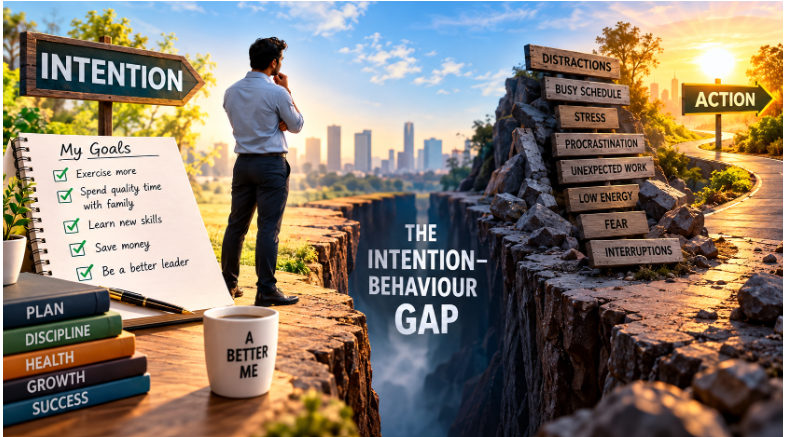
Psychology has a name for this problem: the intention–behaviour gap.
What Is the Intention–Behaviour Gap?
The intention–behaviour gap is the difference between what people genuinely intend to do and what they subsequently do.
It helps explain why good intentions do not always lead to action, even when a goal is meaningful and a person is motivated to achieve it.
The gap appears in familiar situations: intending to exercise but remaining inactive, planning to save money but continuing habitual spending, deciding to give constructive feedback but postponing the conversation, or wanting to develop a new skill without creating the conditions for regular practice.
An intention matters. It expresses direction.
But it does not automatically create action.
Research on the intention–behaviour relationship provides an important perspective. In a meta-analysis of 47 experimental tests, researchers found that interventions producing medium-to-large changes in intentions produced smaller changes in actual behaviour. Strengthening intention helped, but the behavioural change was not equivalent to the change in intention.
That finding challenges a common assumption.
We often believe that if someone wants something strongly enough, action should follow.
Sometimes it does.
But wanting, intending and acting are not interchangeable psychological events.
Why Good Intentions Do Not Always Lead to Action
Consider a professional preparing for an important examination.
Wanting means the qualification is desirable.
Intending means the person has formed a commitment to pursue it.
Deciding may involve selecting a study schedule, resources and examination date.
Starting means opening the material and beginning the work.
Repeating means returning to that work across ordinary days, including those when enthusiasm is absent.
Maintaining means adapting the behaviour as circumstances change.
Each stage introduces different demands.
A person can genuinely want a qualification without deciding when to study.
They can decide when to study but repeatedly allow urgent work to displace that time.
They can begin enthusiastically and then discover that their schedule cannot sustain the original plan.
And they can study regularly without examining whether their method is effective.
The difficulty is not always a weak intention.
Sometimes the intention has not been translated into a sufficiently workable process.
An intention identifies a direction. Behaviour requires a way of moving in that direction under real conditions.
This is especially important for ambitious professionals, who may mistake the seriousness of their commitment for evidence that the necessary action will follow.
The two deserve separate attention.
How Everyday Circumstances Create an Intention–Action Gap
When people form intentions, they often imagine acting under relatively favourable conditions.
There is time to think.
The desired outcome feels important.
The benefits are easy to remember.
Competing demands are temporarily less visible.
But behaviour takes place in a different environment.
The telephone rings. A client requires attention. A team member brings an unexpected problem. Traffic extends the journey home. Someone in the family needs help. Fatigue changes what feels manageable.
The intention was formed in one set of circumstances.
The action must survive another.
This does not mean that circumstances explain every failure to act. It means that intentions should be evaluated against the conditions in which they must operate.
A plan that requires uninterrupted concentration every evening may be poorly matched to the life of a senior executive with unpredictable responsibilities.
A commitment to exercise at 6 a.m. may be difficult to sustain for someone whose work regularly ends late.
A plan to have a difficult conversation may remain ineffective if it does not address the discomfort associated with beginning that conversation.
A desirable action is not necessarily an accessible action.
And accessibility changes with context.
The Psychology of Turning Intention Into Action
One of the most useful distinctions in behaviour change concerns the moment at which action must begin.
Imagine a founder who has decided to delegate more responsibility.
The intention is sincere. The founder understands that the business cannot grow if every decision continues to pass through one person.
Then a team member makes a mistake.
At that moment, the familiar response becomes attractive: take control, correct the work personally and promise to delegate again next time.
The long-term intention favours developing the team.
The immediate situation favours regaining control.
Both possibilities exist, but they do not feel equally comfortable.
This is why a decision made in advance may not determine what happens when the relevant situation arrives.
The immediate environment introduces urgency, emotion, competing priorities and familiar responses.
For some behaviours, starting is the major difficulty.
For others, the challenge is continuing after interruption.
And for still others, the problem is recognising when the opportunity to act has arrived.
These are different problems. They may require different solutions.
Implementation Intentions: How If–Then Planning Supports Behaviour Change
One extensively studied approach to closing the intention–behaviour gap is the implementation intention.
Instead of expressing only a goal, the person specifies a situation and the response they intend to make when that situation occurs.
For example:
“I will become more consistent with exercise” is a goal intention.
“If I finish my morning tea, I will put on my walking shoes and begin a fifteen-minute walk” is an implementation intention.
The second statement links an identifiable cue with a specific behaviour.
It reduces the need to decide from the beginning each time the situation arises.
Research has found that such if–then plans can improve goal attainment. A major meta-analysis of 94 independent tests reported a medium-to-large average effect. A later meta-analysis of 642 independent tests also found beneficial effects across cognitive, emotional and behavioural outcomes, with stronger effects under certain conditions, including motivated participants and rehearsed plans.
These findings do not mean that a simple sentence guarantees change.
They suggest something more practical:
The connection between a situation and an intended response can be strengthened before the situation occurs.
In professional life, that might look like this:
If a team member brings me a problem they could reasonably solve, I will first ask what options they have considered.
Or:
If a meeting begins moving towards blame, I will ask the group to separate what happened from what we are assuming happened.
Or:
If I return home later than expected, I will complete a shorter study session rather than abandoning the day entirely.
The quality of the plan depends on whether it addresses a genuine behavioural difficulty.
A beautifully written plan that ignores reality remains a beautifully written plan.
Why Consistency Requires Planning for Interruptions
Many people plan for success but not for disruption.
They decide what they will do if everything proceeds normally.
They do not decide what happens when the meeting runs late, the child needs attention, the client calls, the first attempt fails or the emotional conditions become less favourable.
This omission matters because consistency is not the absence of interruption.
It is partly the ability to return after interruption.
Consider two professionals preparing for the same examination.
The first creates a demanding schedule requiring two uninterrupted hours every evening.
The second establishes a preferred two-hour study period but also decides what to do when only twenty minutes are available.
The second plan is not necessarily more ambitious.
It may simply be more compatible with the unpredictability of ordinary life.
A useful question therefore emerges:
Have I planned only for the behaviour I want, or also for the conditions most likely to prevent it?
This question is relevant to personal habits, professional development, leadership conversations and organisational change.
It shifts attention from enthusiasm to preparedness.
Motivation vs Action: Why Motivation Alone Is Not Enough
Motivation is often treated as the main ingredient of action.
When action does not occur, people assume they need more of it.
Sometimes motivation is genuinely insufficient.
A goal may not matter enough. The expected benefit may be unclear. The cost may outweigh the perceived value.
But motivation is only one part of the picture.
A person may care deeply about a goal and still face obstacles involving time, resources, competing responsibilities, skills or an environment that makes the desired behaviour difficult.
This is why telling someone to become more motivated can be unhelpful when the real difficulty lies elsewhere.
A leader may be motivated to communicate more openly but work in an organisation where disagreement is routinely punished.
An employee may intend to develop new skills but have no protected time for learning.
A person may want to improve sleep but face persistent work demands or a sleep-related health problem requiring professional evaluation.
These situations cannot be resolved adequately by enthusiasm alone.
Before asking how to increase motivation, it may be more useful to ask what is preventing an existing intention from becoming possible, practical or repeatable.
When Planning Feels Like Progress but Behaviour Has Not Changed
There is a quieter complication.
Forming an intention can itself feel satisfying.
Deciding to begin a new routine creates a sense of direction.
Buying a book creates a sense of preparation.
Registering for a course creates a sense of commitment.
Announcing a goal can make the future feel more organised.
None of these actions is inherently meaningless.
Preparation can be essential.
But preparation and progress should not be confused.
A senior manager who repeatedly enrols in leadership programmes may genuinely value development. Yet the important question is whether anything changes in the conversations, decisions and relationships that constitute their leadership.
A professional who purchases increasingly sophisticated planning tools may be committed to productivity. Yet the tools become valuable only when they support work that matters.
The issue is not that planning feels good.
It is that the emotional satisfaction of preparing for change can sometimes arrive before the behavioural demands of change have been met.
This possibility deserves examination without turning it into a universal explanation for procrastination.
What Research Says About the Intention–Behaviour Gap
The intention–behaviour gap is not merely an anecdotal observation.
A 2023 systematic review and meta-analysis of physical activity research examined 25 independent samples involving 29,600 participants. Among participants who intended to be physically active, the estimated intention–behaviour gap was 47.6%.
That is a substantial discrepancy.
However, it is important not to generalise the percentage to every human behaviour. The study concerned physical activity, and intention–behaviour relationships vary across domains, populations, circumstances and measurement approaches.
Similarly, evidence supporting implementation intentions does not establish that planning can overcome every obstacle.
An if–then plan cannot create financial resources that are unavailable.
It cannot remove every organisational constraint.
It cannot make an unsafe environment safe.
And it cannot replace appropriate professional support when behavioural difficulties are connected with medical or psychological conditions requiring specialised care.
Behaviour change deserves scientific humility because human action is shaped by more than a single psychological mechanism.
The value of research is not that it supplies one universal formula.
It helps us ask better questions about why action does or does not occur.
Five Questions to Help Turn Good Intentions Into Action
Suppose there is something you have genuinely intended to do for several weeks.
Instead of immediately making another promise to yourself, examine the intention through five questions.
1. Is the intention sufficiently specific?
“I want to improve my leadership” describes a desirable direction.
It does not identify a behaviour.
“During my next review meeting, I will ask for the employee's assessment before offering my own” creates something observable.
2. When exactly must the action occur?
A goal that has no identifiable opportunity for action may remain permanently available for tomorrow.
The relevant question is not only what you intend to do, but when the opportunity to begin will become recognisable.
3. What usually happens at that moment?
Perhaps another task takes priority.
Perhaps discomfort appears.
Perhaps the environment encourages the old behaviour.
Perhaps the necessary resources are missing.
Observe the obstacle rather than assuming its cause.
4. What is the smallest meaningful response?
A smaller action is not always the best action.
But reducing unnecessary difficulty can make starting more realistic.
A fifteen-minute study session may not complete a qualification, but it may preserve engagement on a demanding day.
5. What will happen after interruption?
Will one missed day become a missed week?
Will an unsuccessful conversation lead to another attempt?
Will the plan be adjusted when circumstances change?
A workable intention includes a way to recover.
These questions are not a diagnostic instrument or a guarantee of results.
They are a practical method for examining whether an intention has been connected to the conditions of action.
From Good Intentions to Behavioural Readiness
There is a meaningful difference between being committed to an outcome and being ready to perform the behaviours that contribute to it.
Commitment concerns importance.
Behavioural readiness concerns the practical relationship between a person, a situation and a possible action.
A leader may be committed to becoming less reactive.
Readiness becomes more visible when they recognise the situations that trigger defensiveness, identify a useful alternative response and practise making that response available.
A professional may be committed to continuous learning.
Readiness becomes more visible when learning has a place in the calendar, necessary resources are accessible and predictable interruptions have been considered.
An athlete may be committed to better performance.
Readiness involves more than wanting a result; it includes preparation, appropriate practice and responses that can be used under competitive conditions.
The shift is subtle but important.
Instead of repeatedly asking, “How badly do I want this?”, we begin asking:
“What needs to be in place for the intended behaviour to become more likely when the moment arrives?”
That question respects motivation without asking it to perform the work of an entire behavioural system.
Closing the Intention–Behaviour Gap Begins With a Better Question
Good intentions deserve respect.
They often reflect what a person values, hopes to become or wants to contribute.
But intentions also deserve examination.
Not every intention is feasible in its original form. Not every commitment has been translated into action. Not every failure to act indicates a failure of character.
Sometimes the goal needs clarification.
Sometimes the plan needs revision.
Sometimes the environment needs to change.
Sometimes support is necessary.
And sometimes the most important discovery is that a person has been repeatedly preparing to act without adequately preparing for the moment when action becomes difficult.
The purpose of understanding the intention–behaviour gap is not to become suspicious of our intentions. It is to become more responsible for what happens after we form them.
A good intention may tell us where we want to go.
The more revealing question is what we have made possible when the opportunity to move finally arrives.
Dr. Vijay Arora Principle
An intention becomes more useful when it is connected not only to what we want to achieve, but to the circumstances in which we must act.
A Question to Carry Forward
What is one intention you genuinely hold today for which you have not yet created a reliable opportunity to act?